About
I began my career in 2022 with a language I had never heard of before Golang. This was the turning point when I truly started delving into programming, focusing on core concepts and design principles. I'm generally interested in technology, SaaS, psychology, and learning to make the perfect pancakes. I like to explore new technologies and keep building cool projects. Generally, I work on small projects, and most of the time, you'll find me working solo. My favorite tech stack is Next.js, MongoDb and Golang. I also enjoy traveling and cooking food. In the past, I pursued a degree in computer science and engineering, interned at tech companies in Bangalore, India, and competed in over 27+ hackathons for fun.
Right now I'm working on AI agent infrastructure - audit trails, authorization, and voice/video pipelines - and writing more Rust.
I also publish post-mortems: 50+ internship rejections in 2021, and an AI video SaaS I shut down and open-sourced. The wins are easy to talk about; the failures taught me more.
Work Experience
Languages & Frameworks
Databases
Infrastructure
Platforms & Services
Cloud
I build tools for backend engineers
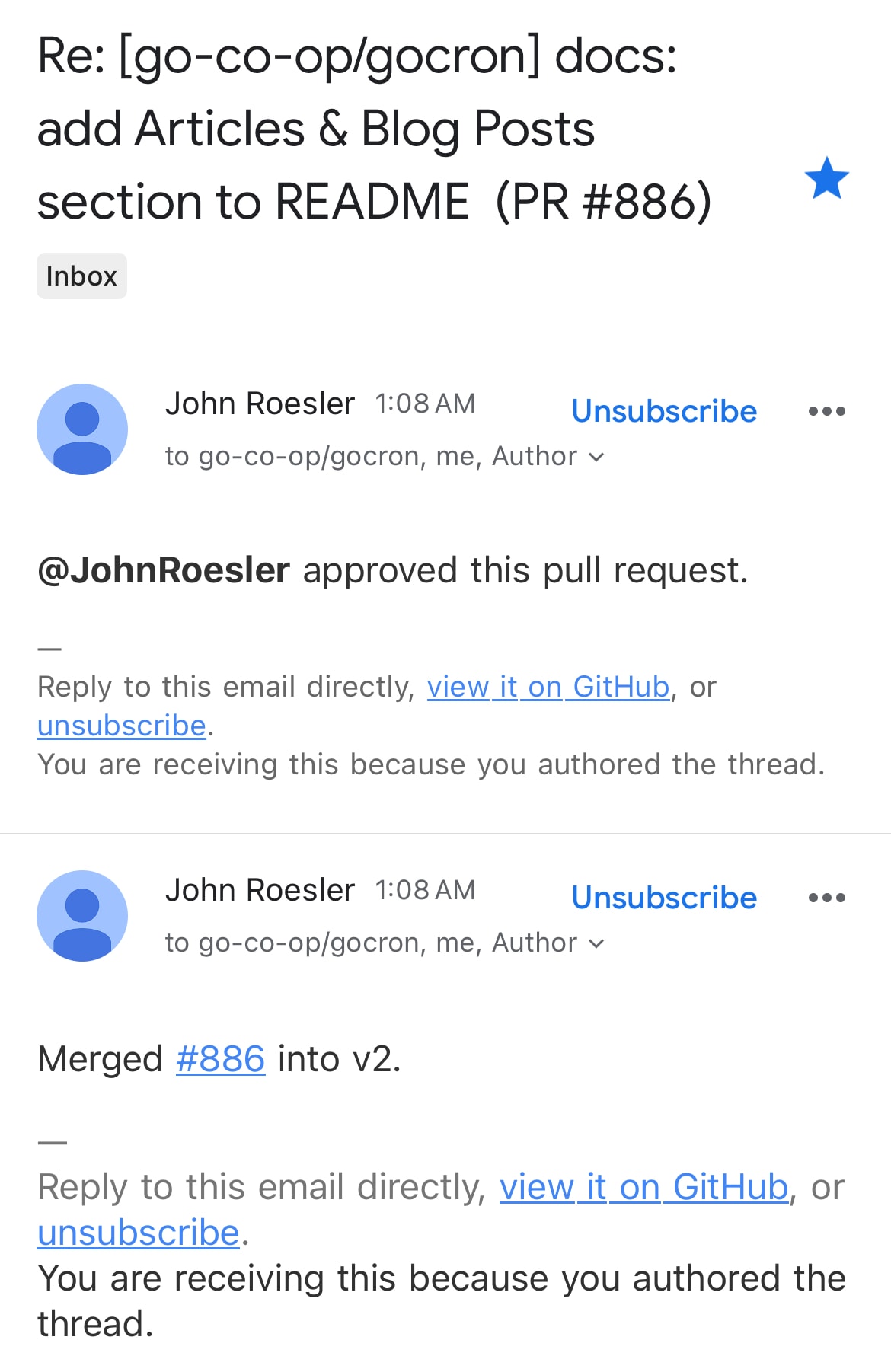
Libraries, SDKs and CLIs I maintain - worker pools, performance monitoring, project scaffolding, API clients and developer tooling. Mostly Go, some Rust and TypeScript. Most started as something I needed at work.
go-co-op maintainer · featured in awesome-go · 400+ GitHub stars across my Go libraries
TokenChit <> Stat cards for AI coding agents | OSS
TokenChit reads your local Claude Code, Codex and OpenCode logs and renders a stat card straight into your repo - tokens used, equivalent API cost, streak and a 30-day activity chart. Unlike hosted badge services the card is a committed file, so it never breaks when someone else's endpoint goes down. Parsing is local; no prompts or file paths leave your machine. Neon supports the project through their Open Source programme and is the Postgres behind the hosted board.
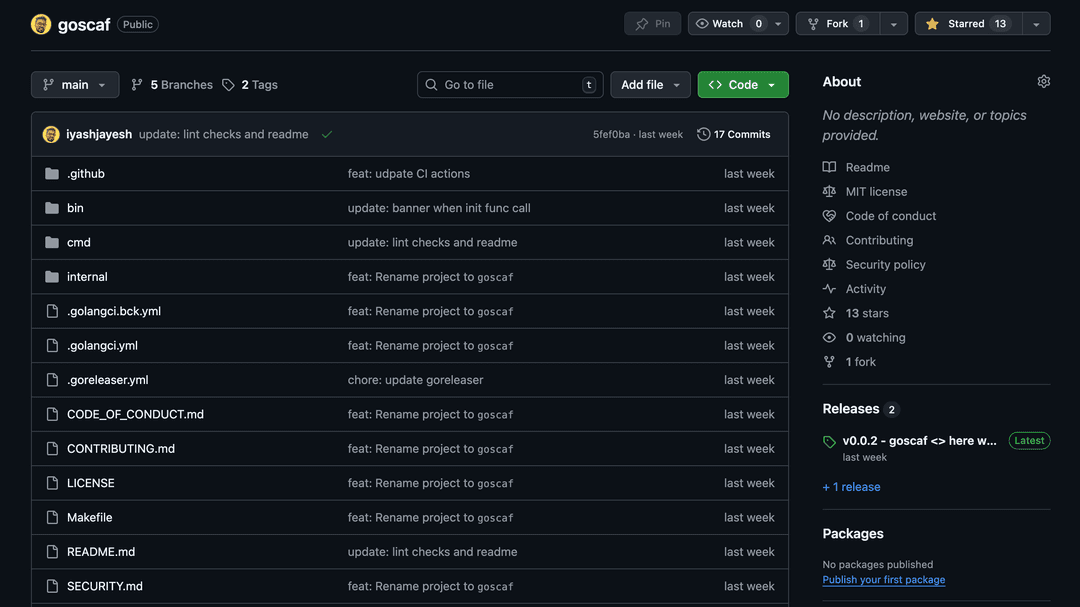
goscaf <> Enterprise-grade Go project scaffolder | OSS
goscaf generates opinionated, production-quality Go project boilerplate via an interactive CLI. Stop copy-pasting skeleton code between projects.
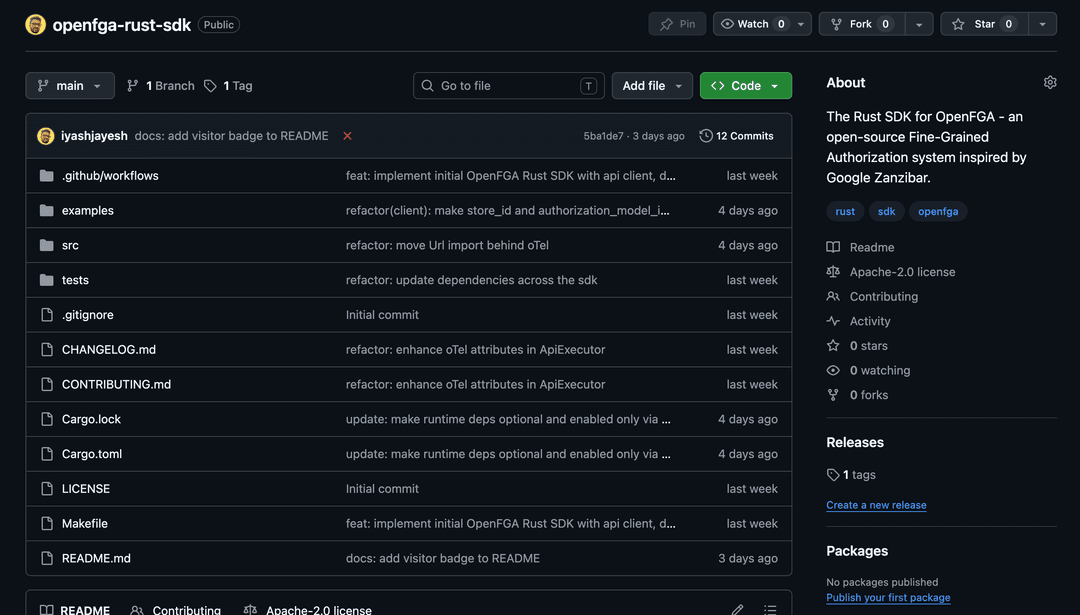
openfga-rust-sdk <> OpenFGA Rust SDK | OSS
The Rust SDK for OpenFGA - an open-source Fine-Grained Authorization system inspired by Google Zanzibar.
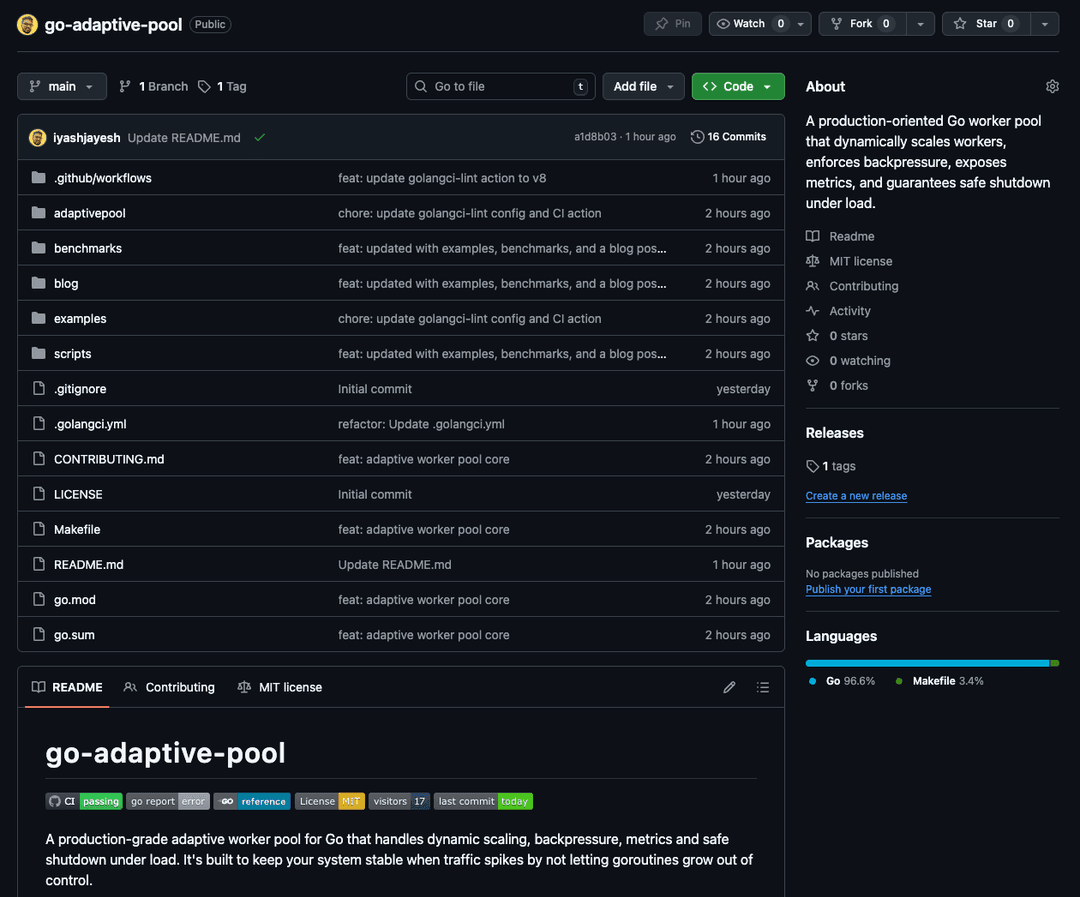
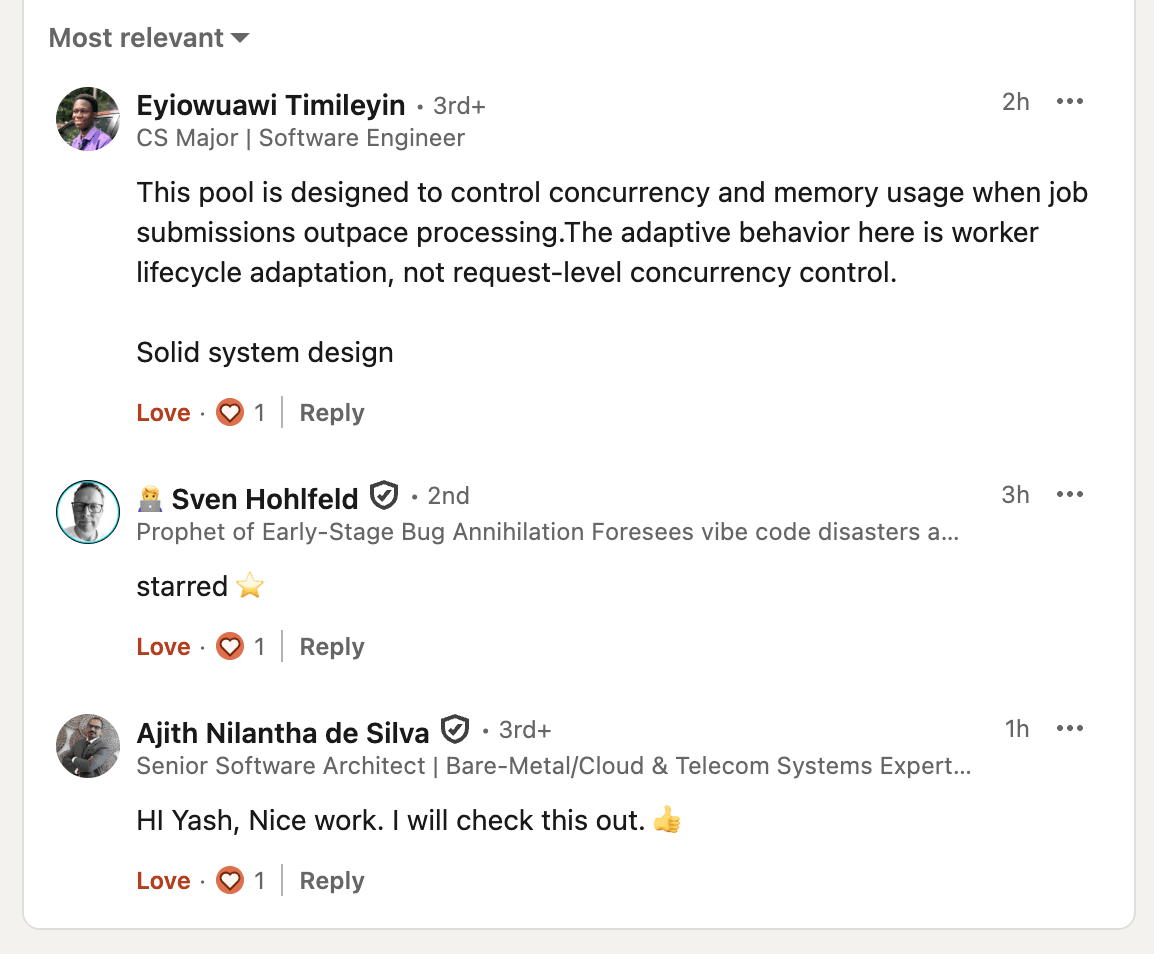
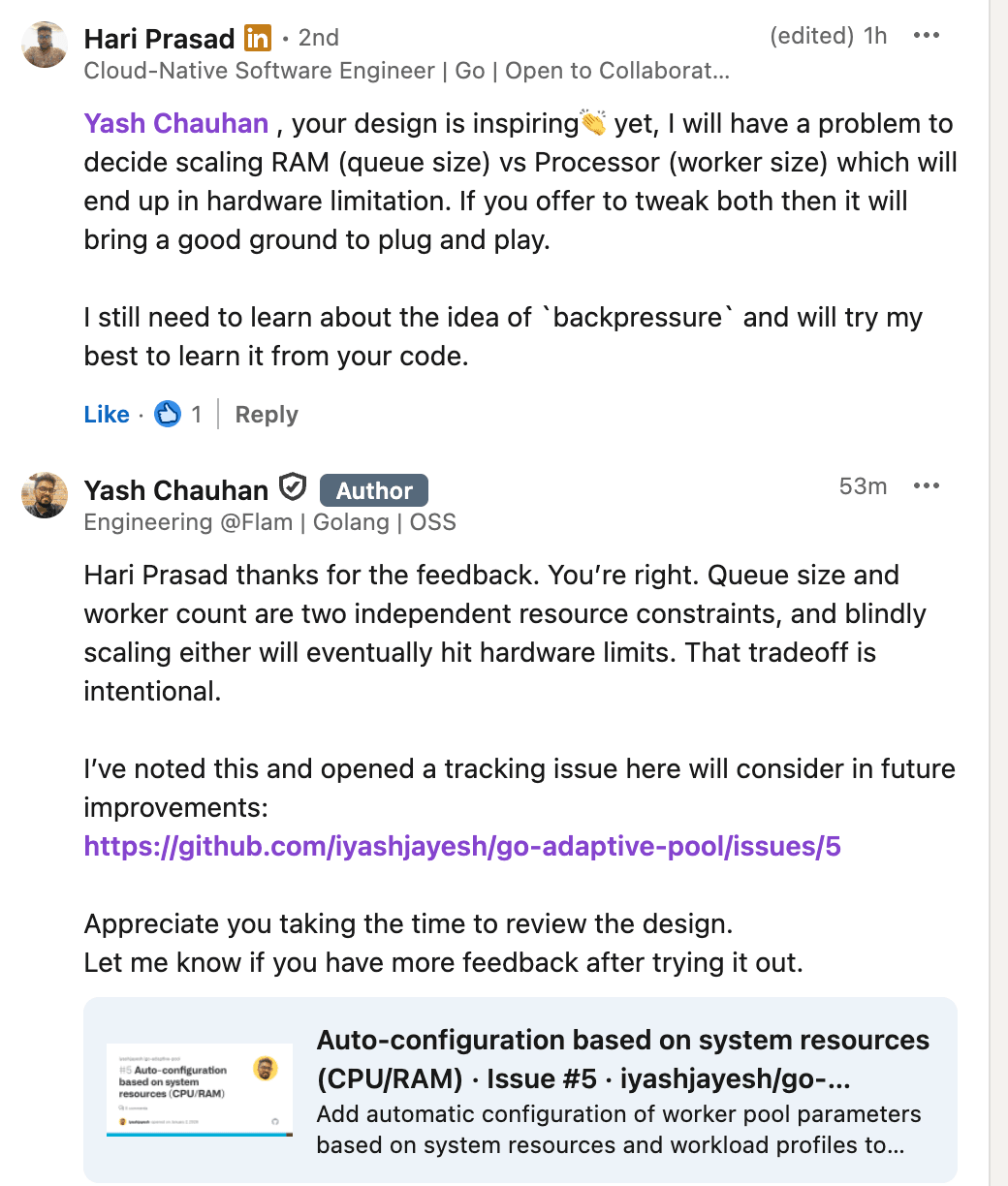
go-adaptive-pool <> Adaptive Pool for Go | OSS
go-adaptive-pool is a bounded worker pool for Go with an adaptive worker lifecycle and explicit backpressure, designed to keep systems stable under bursty load.
MoniGo <> Performance Monitoring for Go Applications | OSS
MoniGo is a performance monitoring library for Go apps, offering real-time insights into service-level and function-level metrics. With an intuitive UI, it enables developers to track and optimize performance. Get your Go app's dashboard up in just 10 seconds!
gocron-ui <> A Web UI for gocron | OSS
gocron-ui a lightweight, real-time web interface for monitoring and controlling gocron scheduled jobs. It provides a complete solution for visualizing job schedules, tracking execution status, and managing jobs through an intuitive web dashboard. Now supports managing and displaying multiple gocron schedulers in a single UI.
Things I've shipped end-to-end
Products I designed, built, and launched solo - including one I shut down and open-sourced.
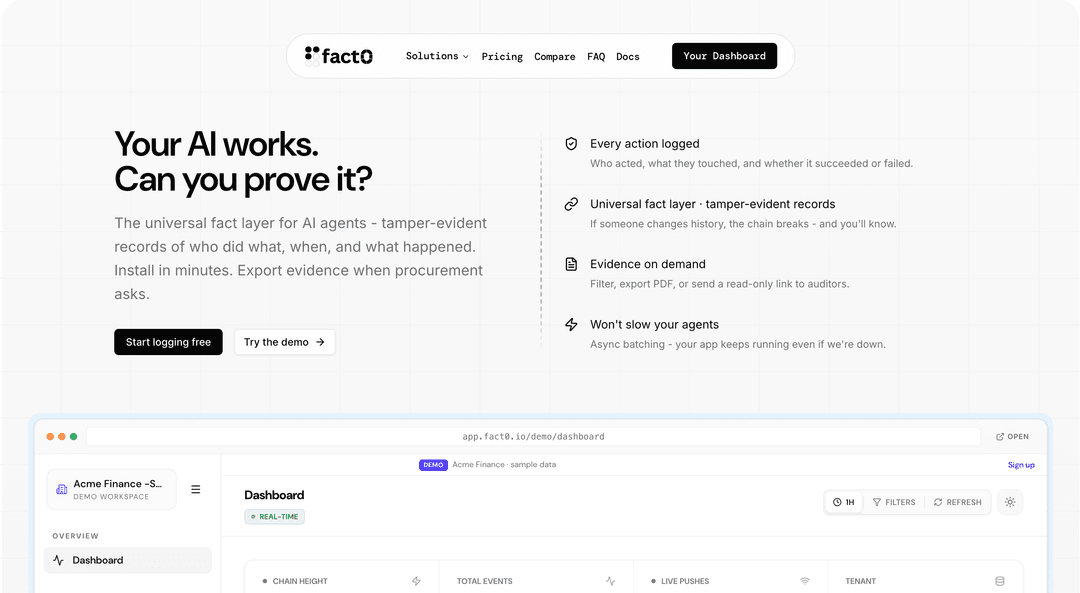
Fact0 - Execution Inspection & Audit Records for AI Agents | OSS
Self-hosted execution inspection and audit records for AI agents, with Python and Claude Code integrations. A Go API, PostgreSQL storage and a Next.js dashboard let you open an execution, walk its parent and child operations, replay recorded activity and verify a hash-linked audit log. Ran as a hosted service until September 2026, then released under MIT once I shut the hosted infrastructure down. A verified chain establishes the integrity of the records that were captured, not complete capture or compliance.
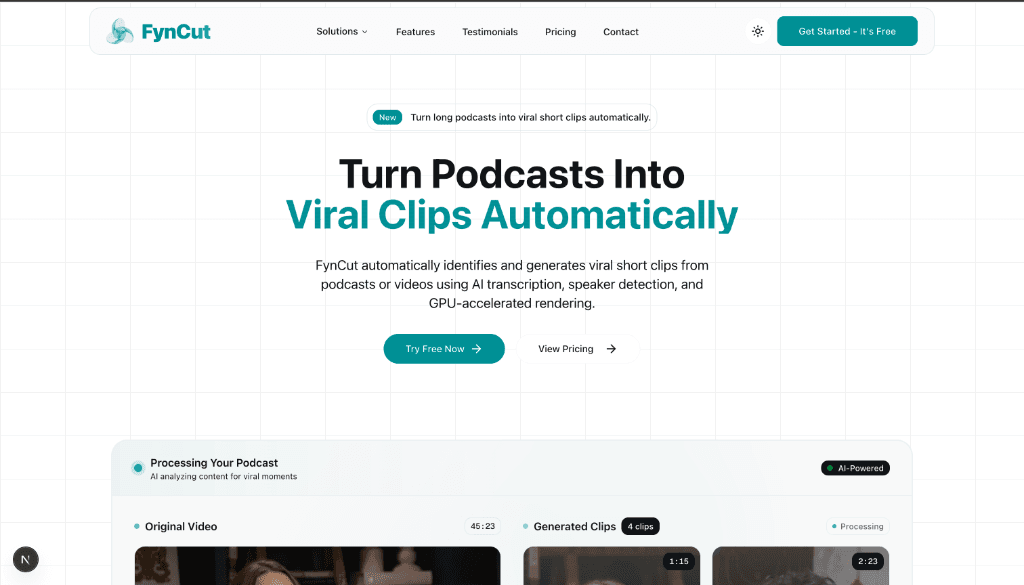
FynCut - AI-Powered Vertical Video Clip Generator | OSS
An AI-powered SaaS platform that automatically cuts long-form podcasts and interviews into viral, vertical (9:16) clips. Built with a scale-to-zero serverless GPU pipeline on Modal running WhisperX (NVIDIA L40S) for word-level transcription, Gemini for highlight extraction, Columbia ASD face tracking (PyTorch/OpenCV) for dynamic reframing, and FFmpeg/pysubs2 for styled caption burning. Orchestrated via Next.js 15, Tailwind v4, Prisma, AWS S3, and Inngest.
Shipping every day
My open source footprint across my repos and the orgs I contribute to, plus how much I lean on AI coding agents to get there.
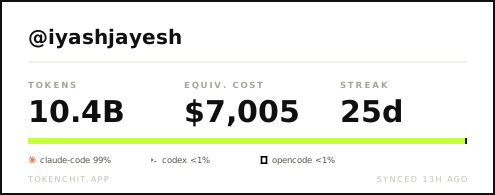
Generated by TokenChit, a CLI I built. It reads local agent logs and commits the card to your repo. Want one? Run npx -y @tokenchit/cli@latest generate in your project.
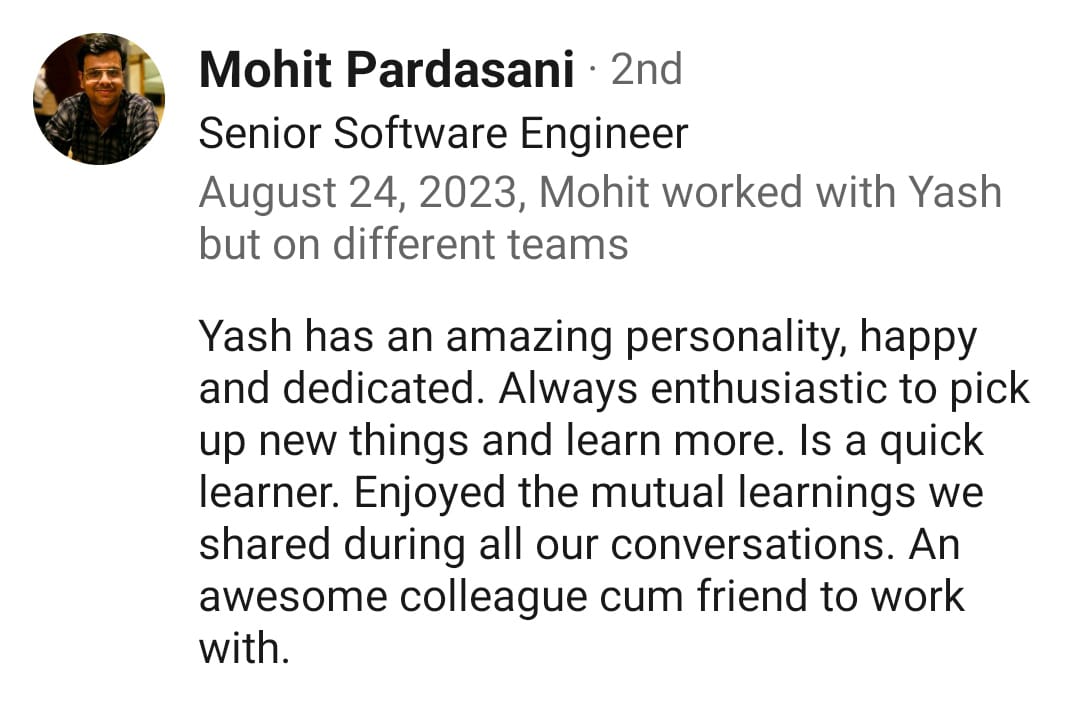
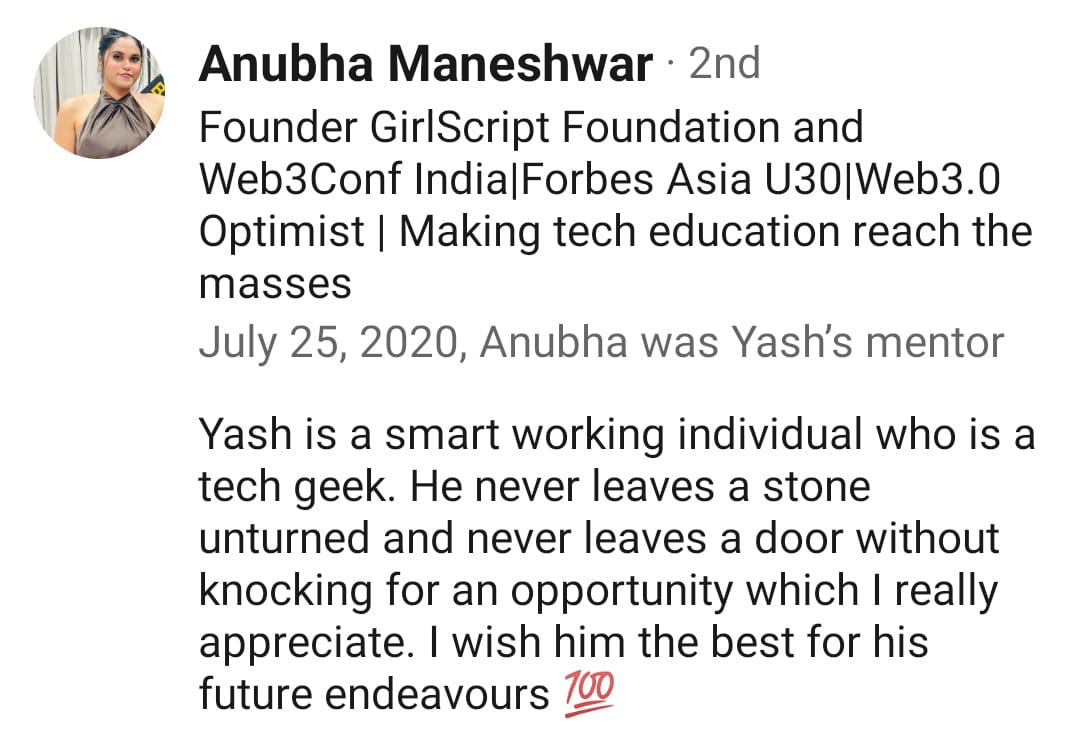
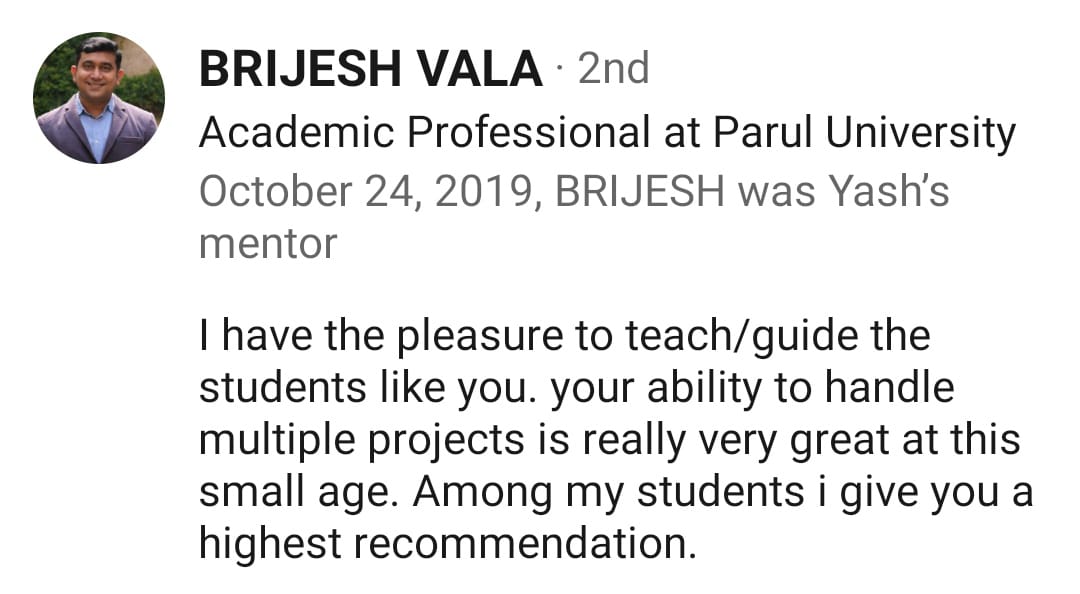
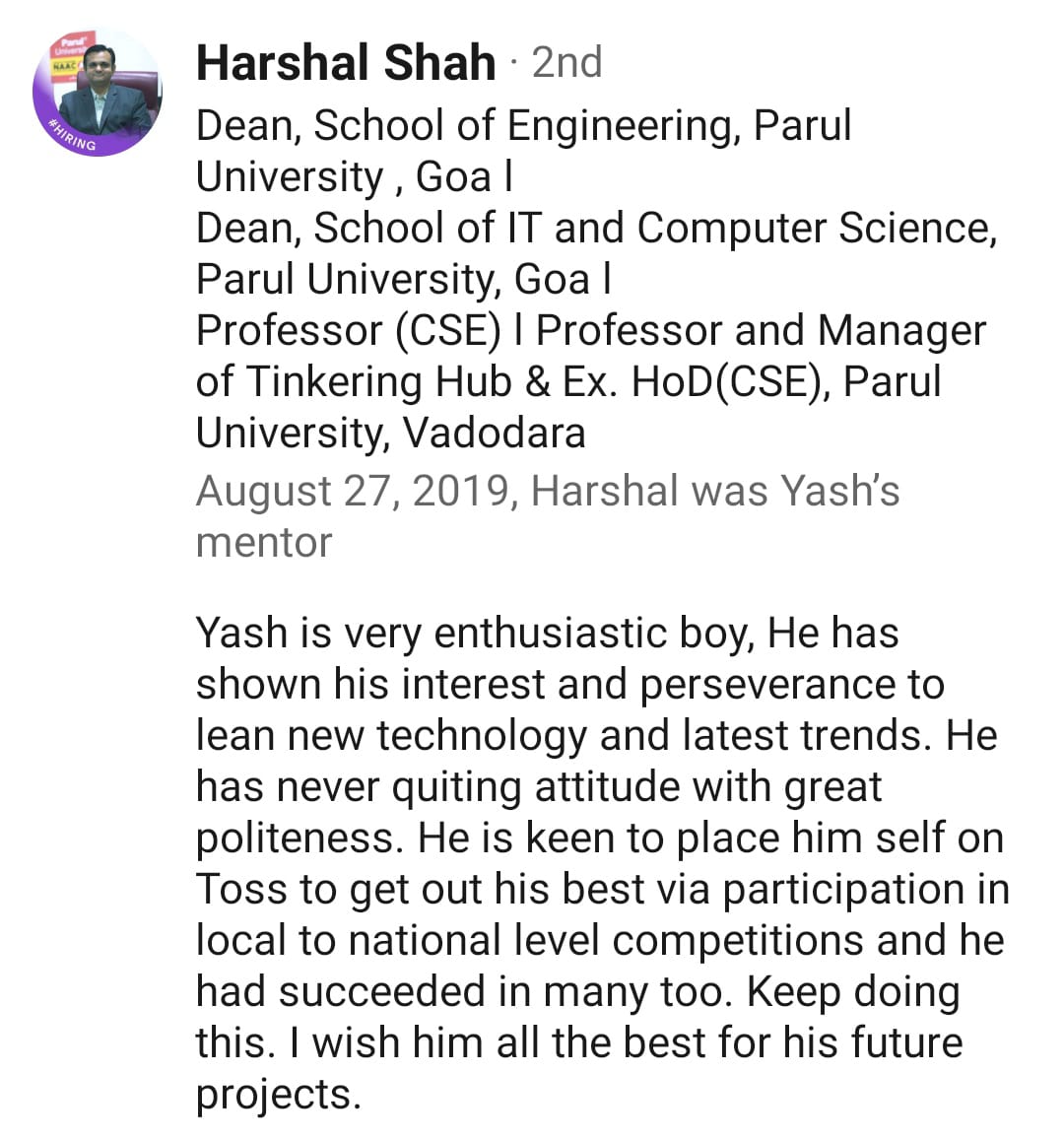
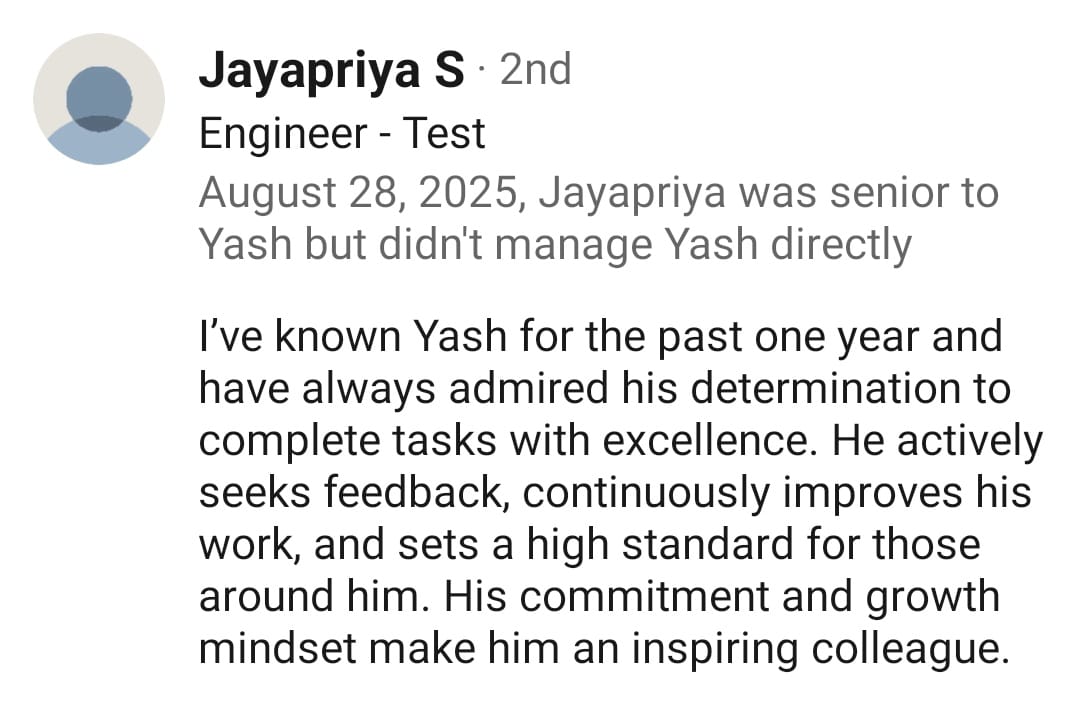
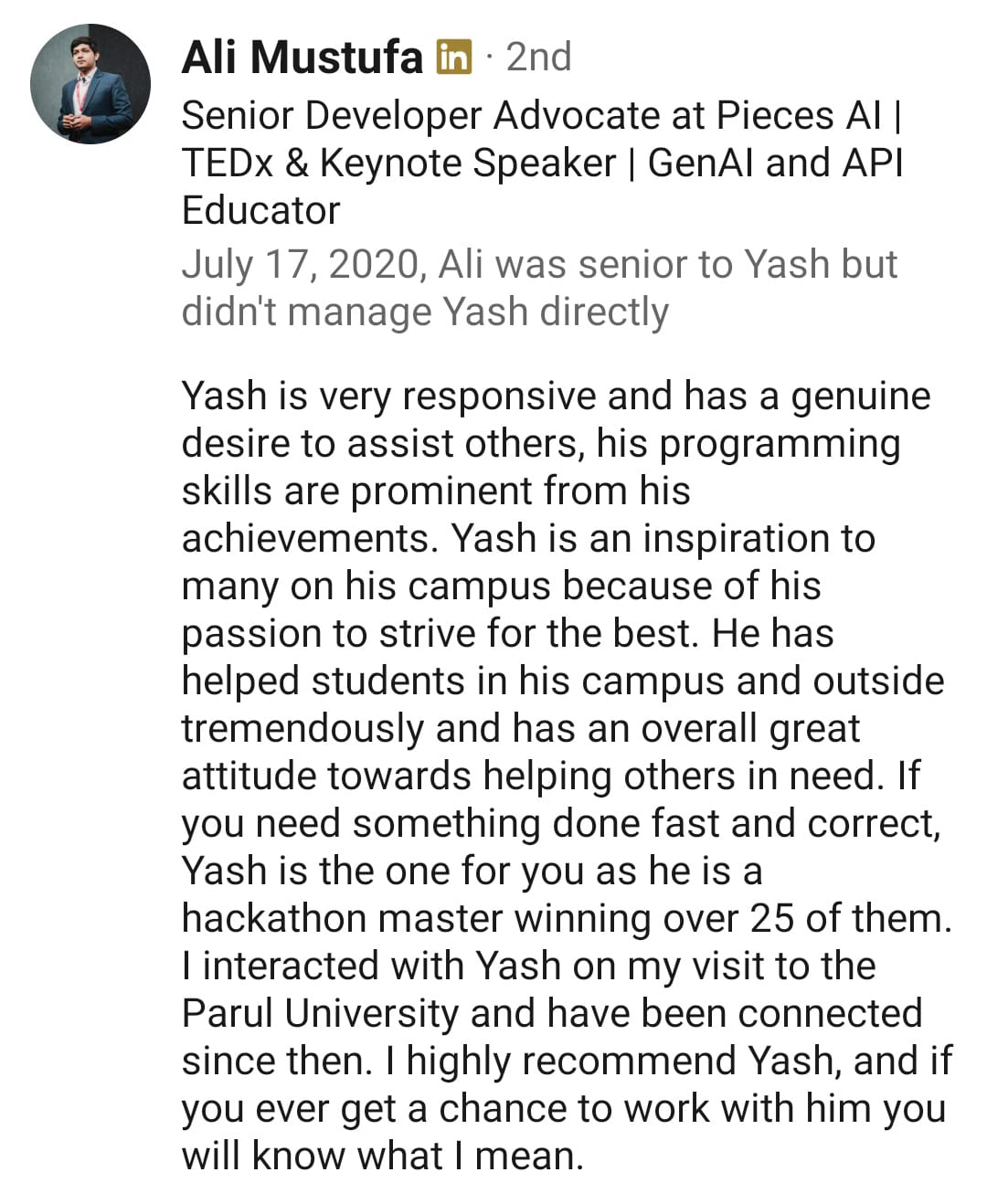
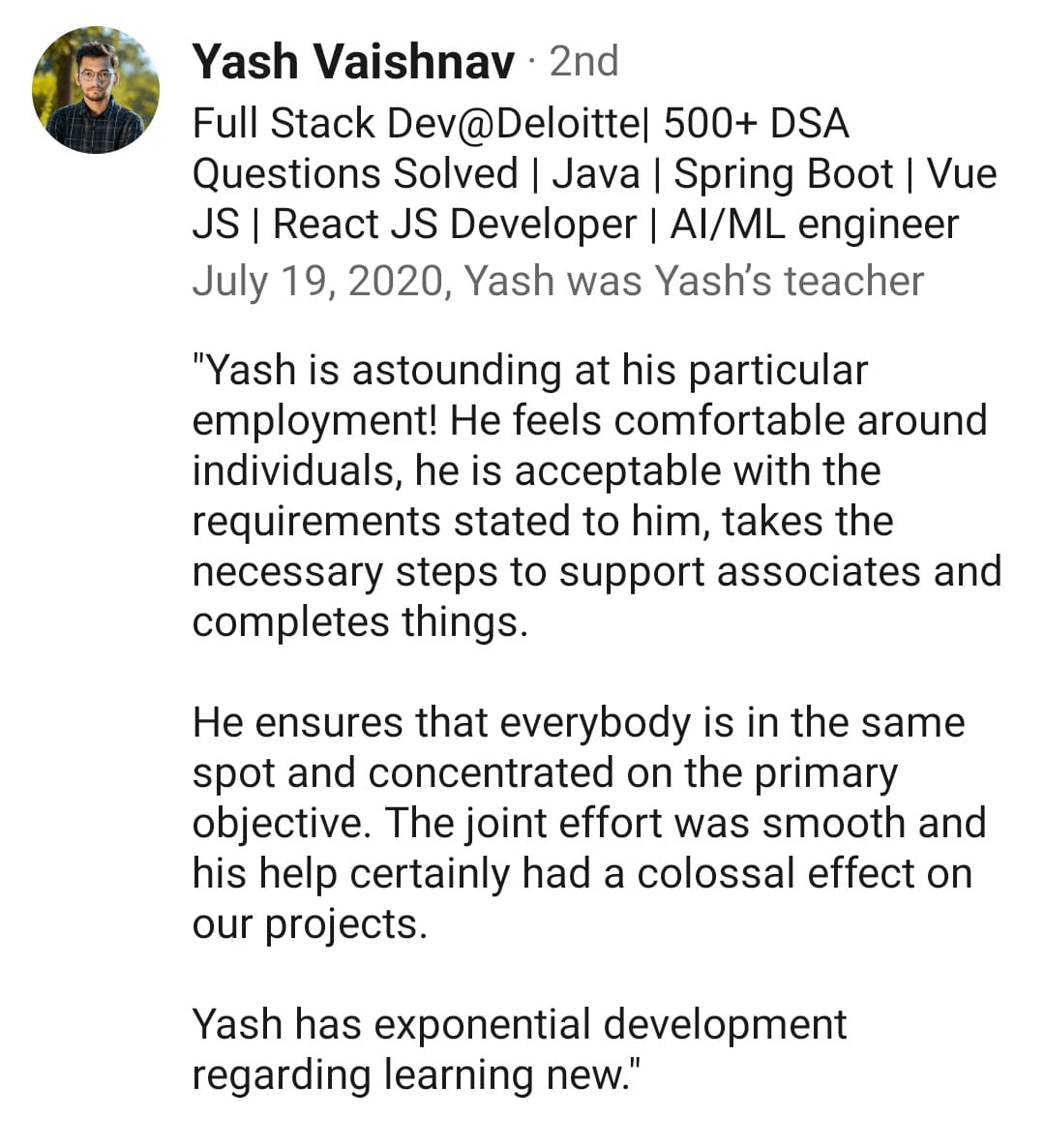
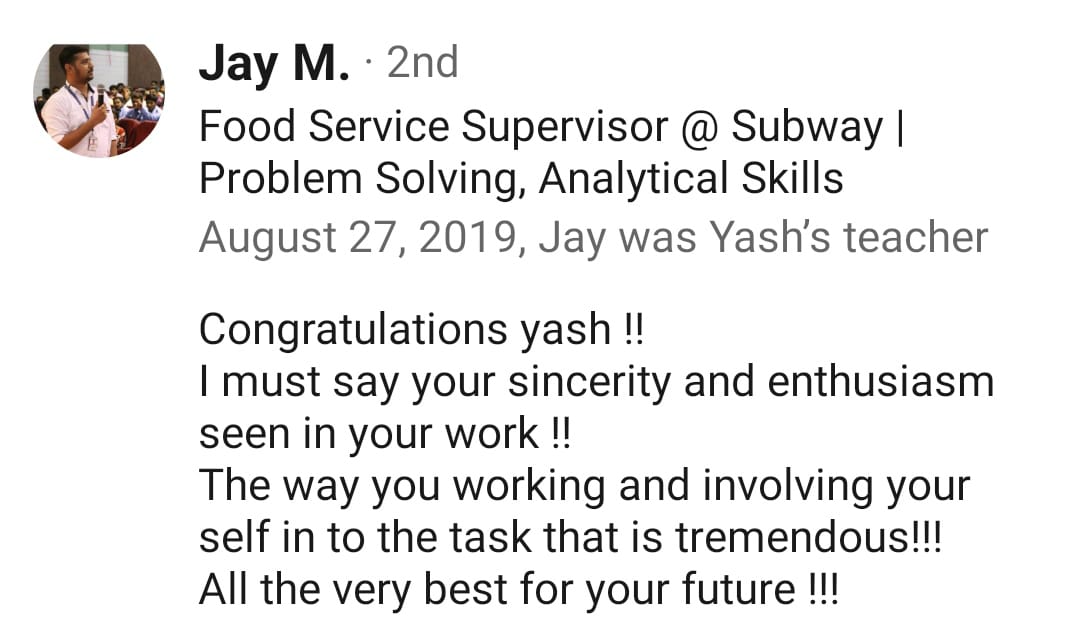
What people I've worked with say
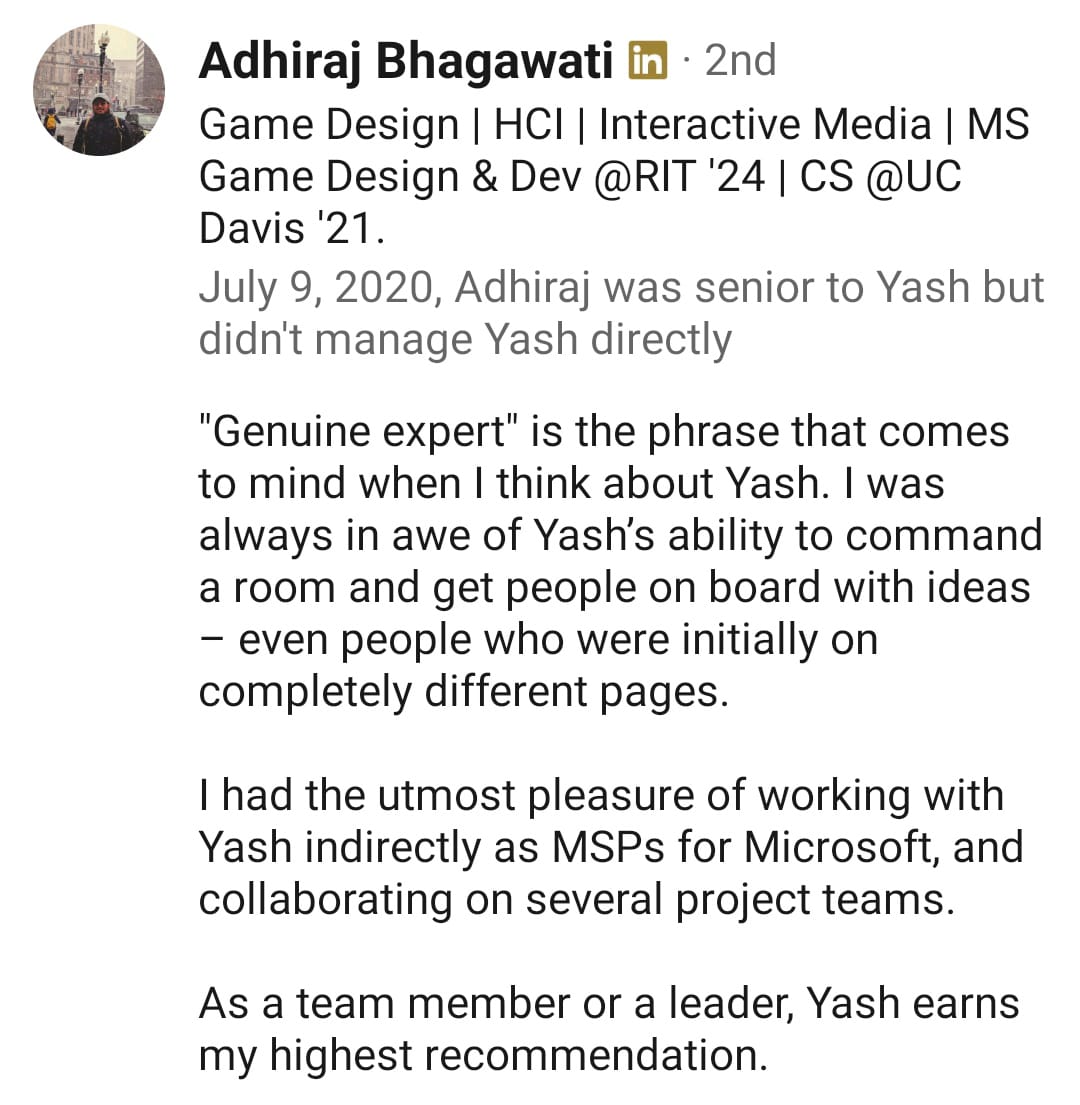
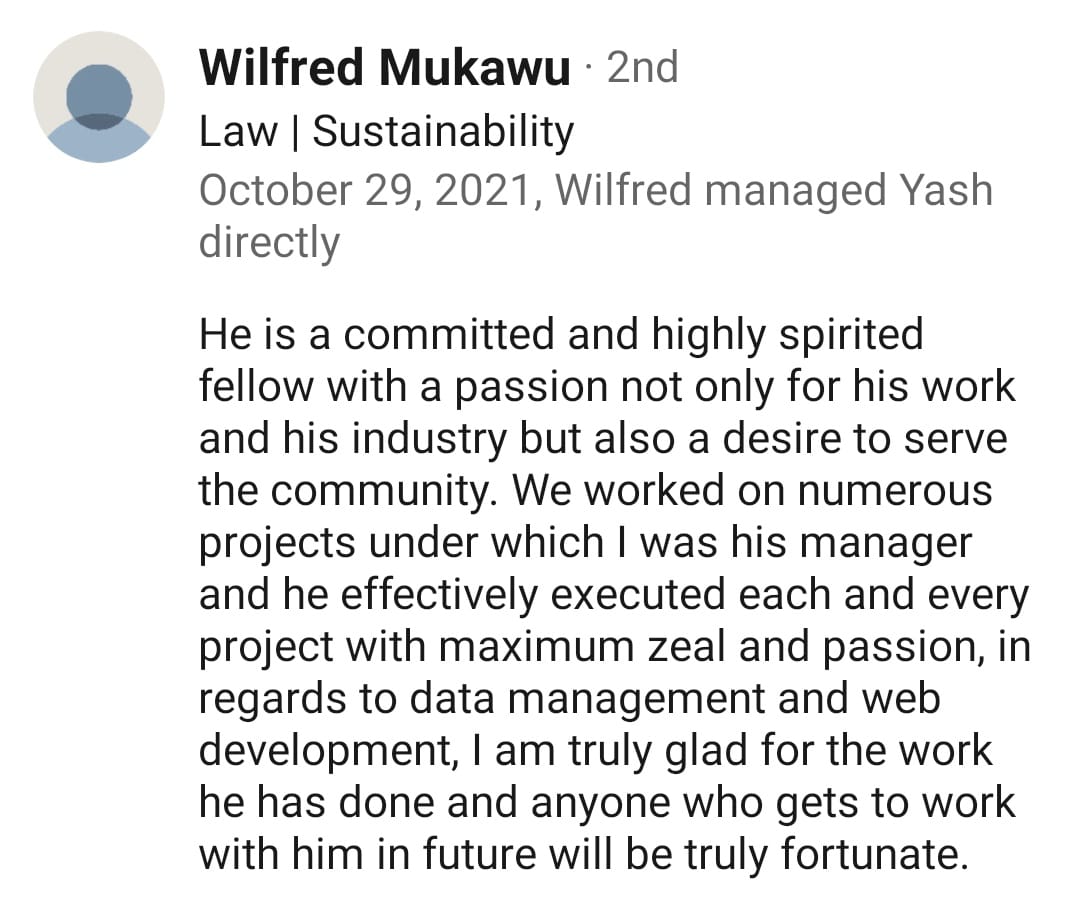
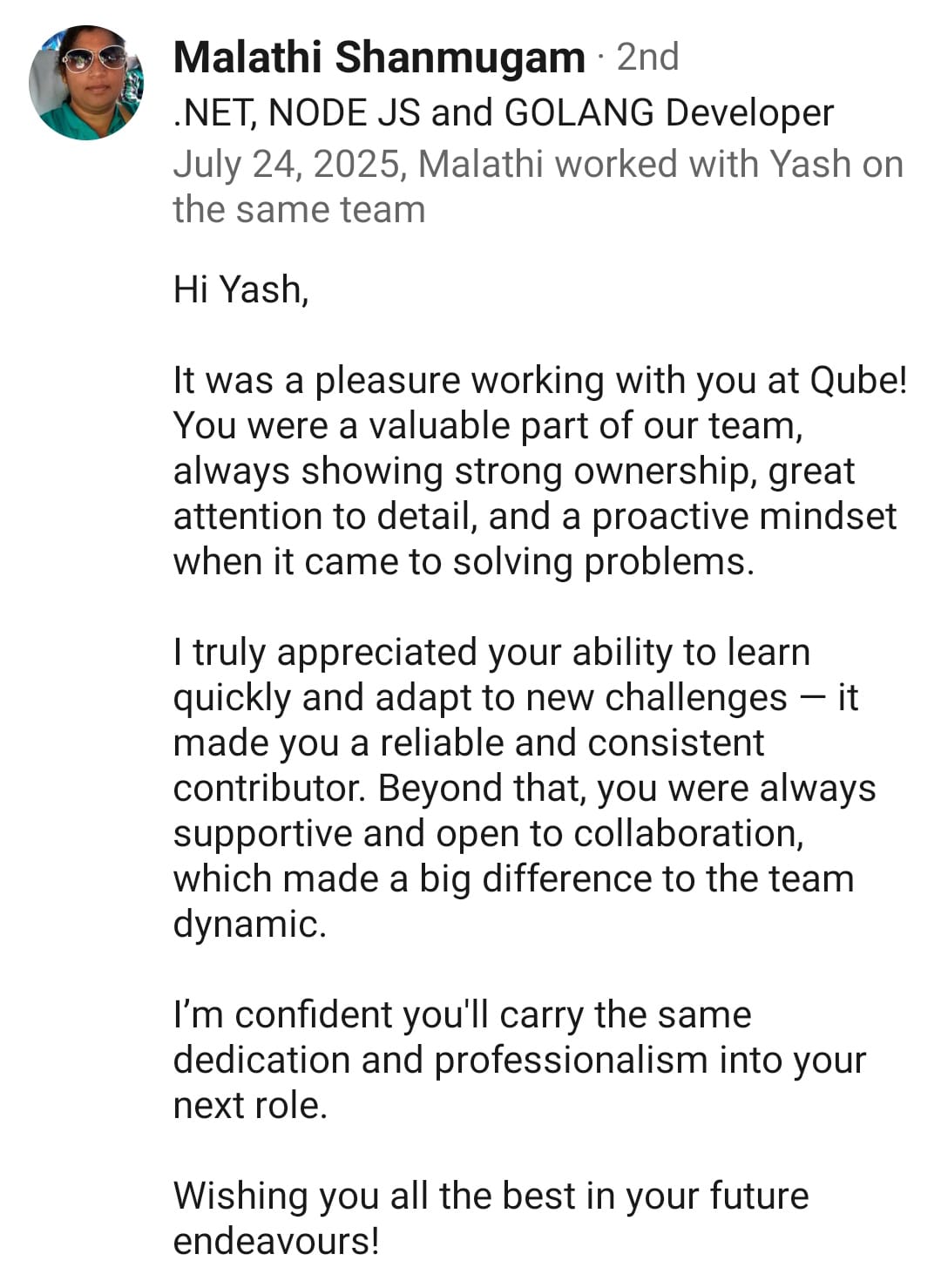
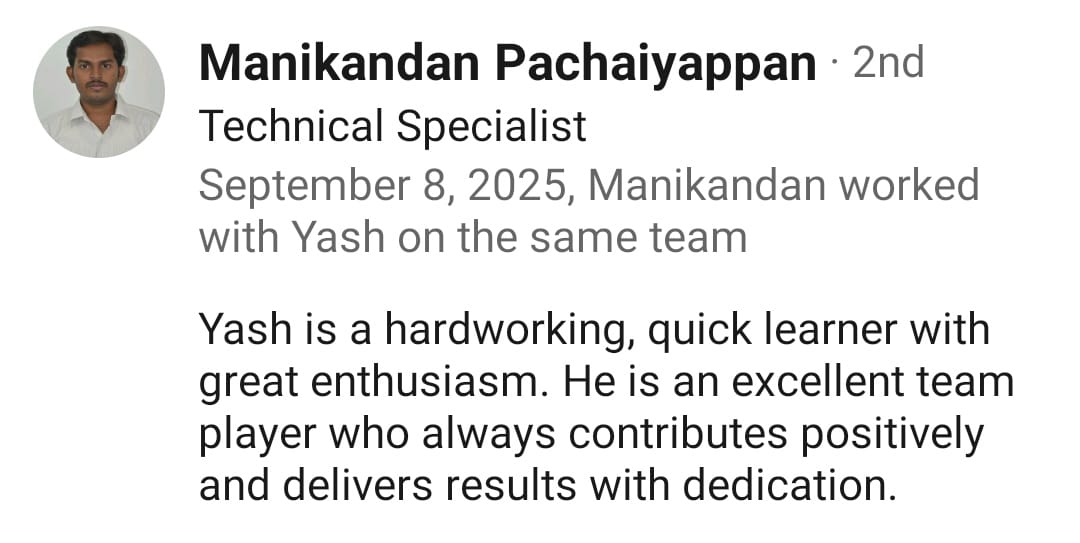
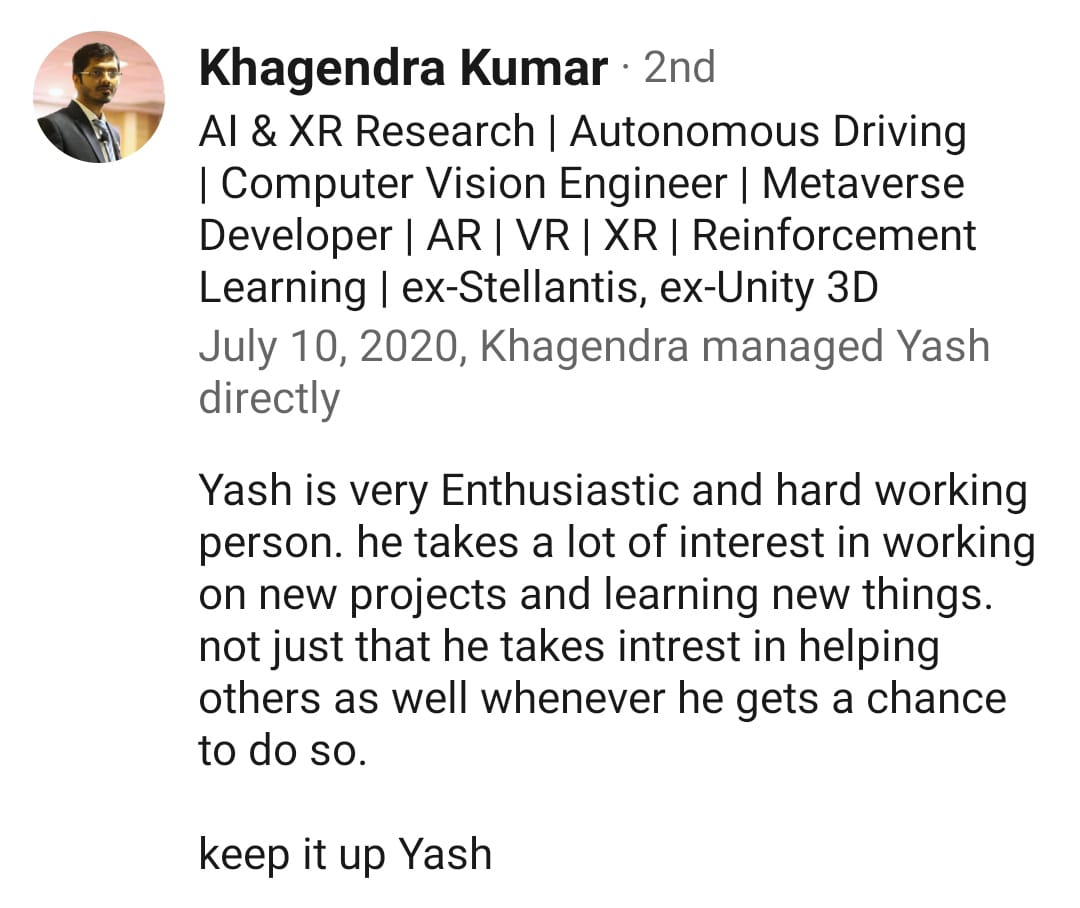
From managers and engineers I shipped production systems alongside.
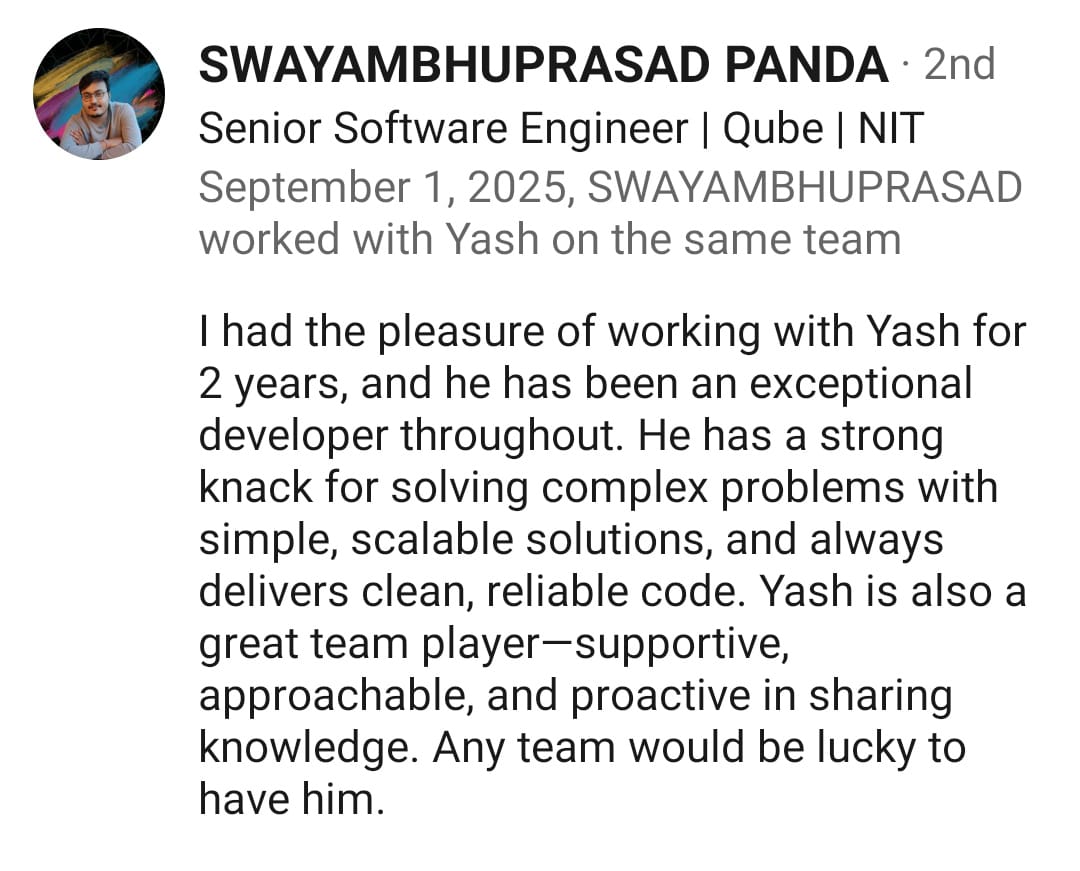
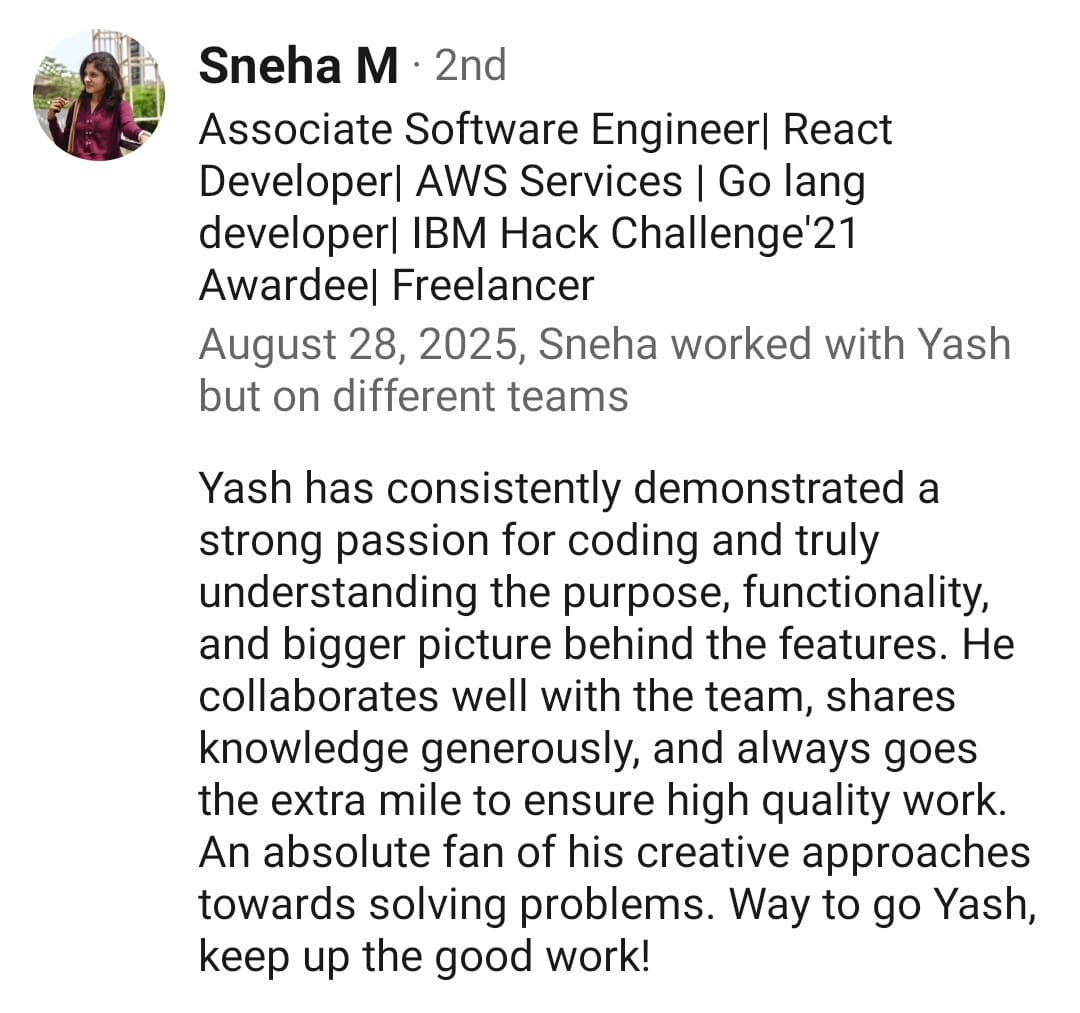
“I had the pleasure of working with Yash for 2 years, and he has been an exceptional developer throughout. He has a strong knack for solving complex problems with simple, scalable solutions, and always delivers clean, reliable code. Yash is also a great team player - supportive, approachable, and proactive in sharing knowledge. Any team would be lucky to have him.”
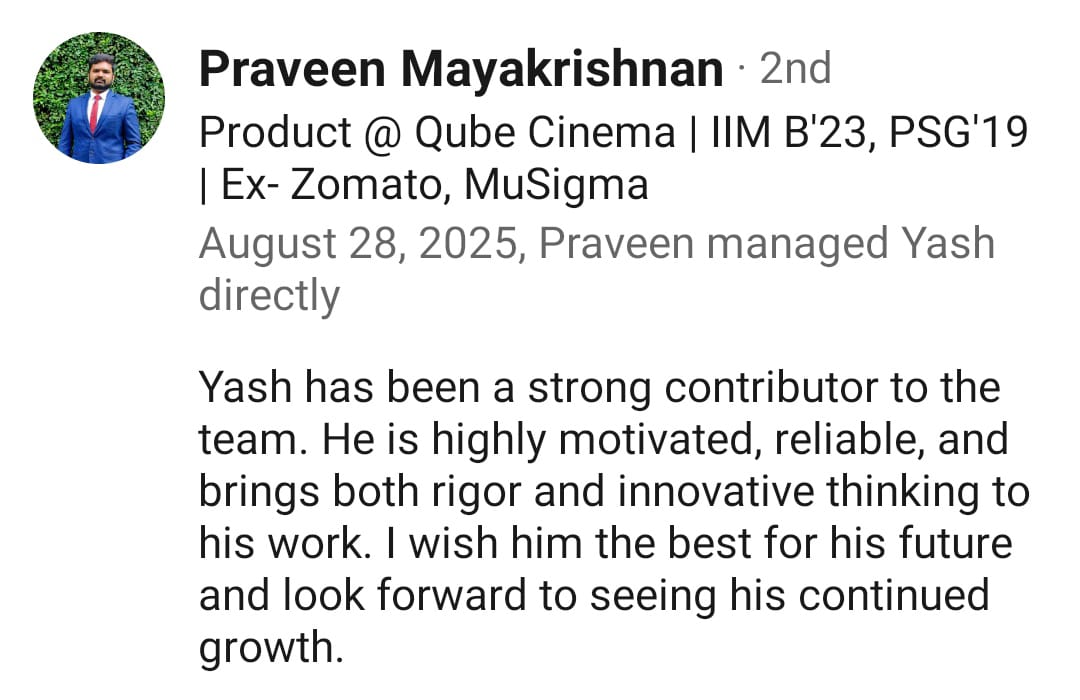
“Yash has been a strong contributor to the team. He is highly motivated, reliable, and brings both rigor and innovative thinking to his work. I wish him the best for his future and look forward to seeing his continued growth.”
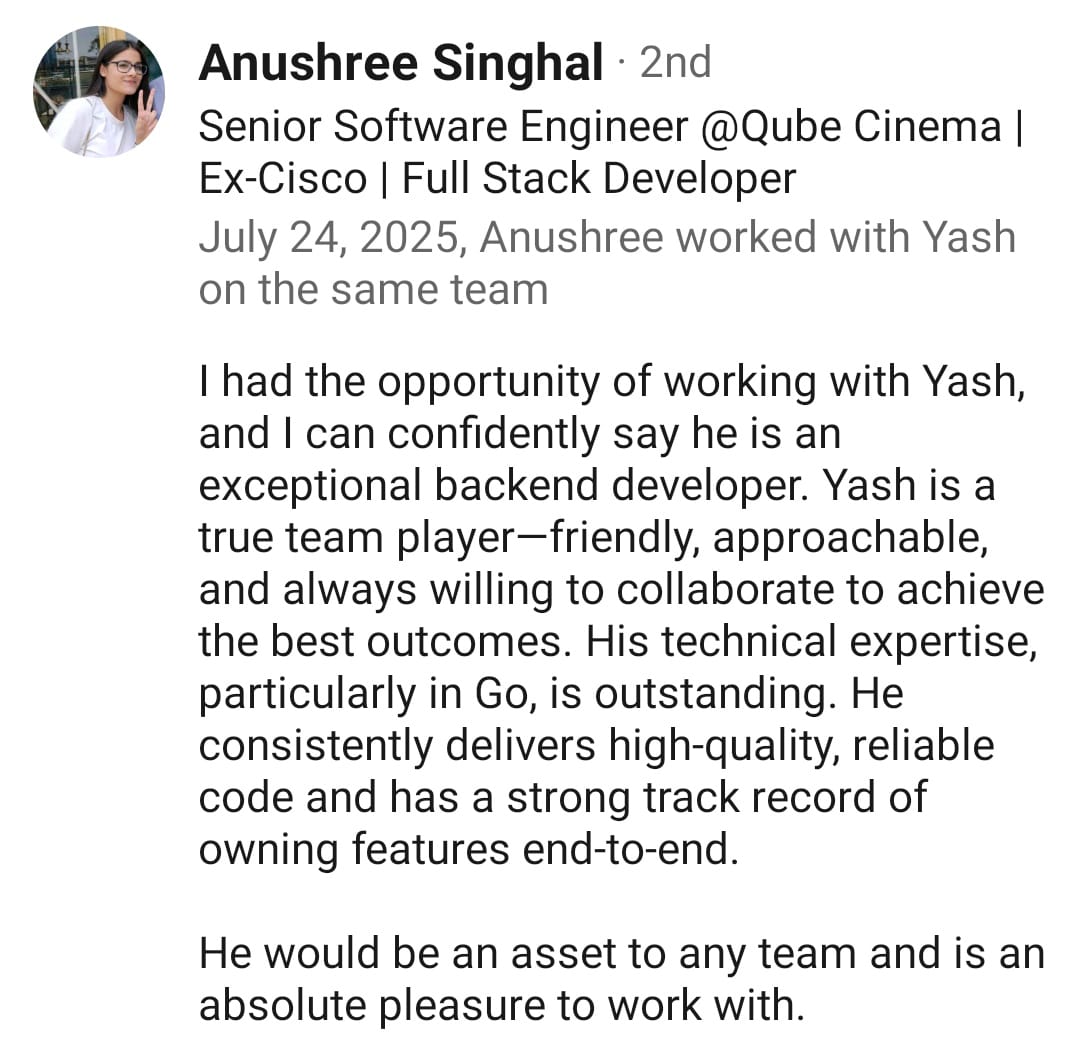
“I had the opportunity of working with Yash, and I can confidently say he is an exceptional backend developer. Yash is a true team player - friendly, approachable, and always willing to collaborate to achieve the best outcomes. His technical expertise, particularly in Go, is outstanding. He consistently delivers high-quality, reliable code and has a strong track record of owning features end-to-end. He would be an asset to any team and is an absolute pleasure to work with.”
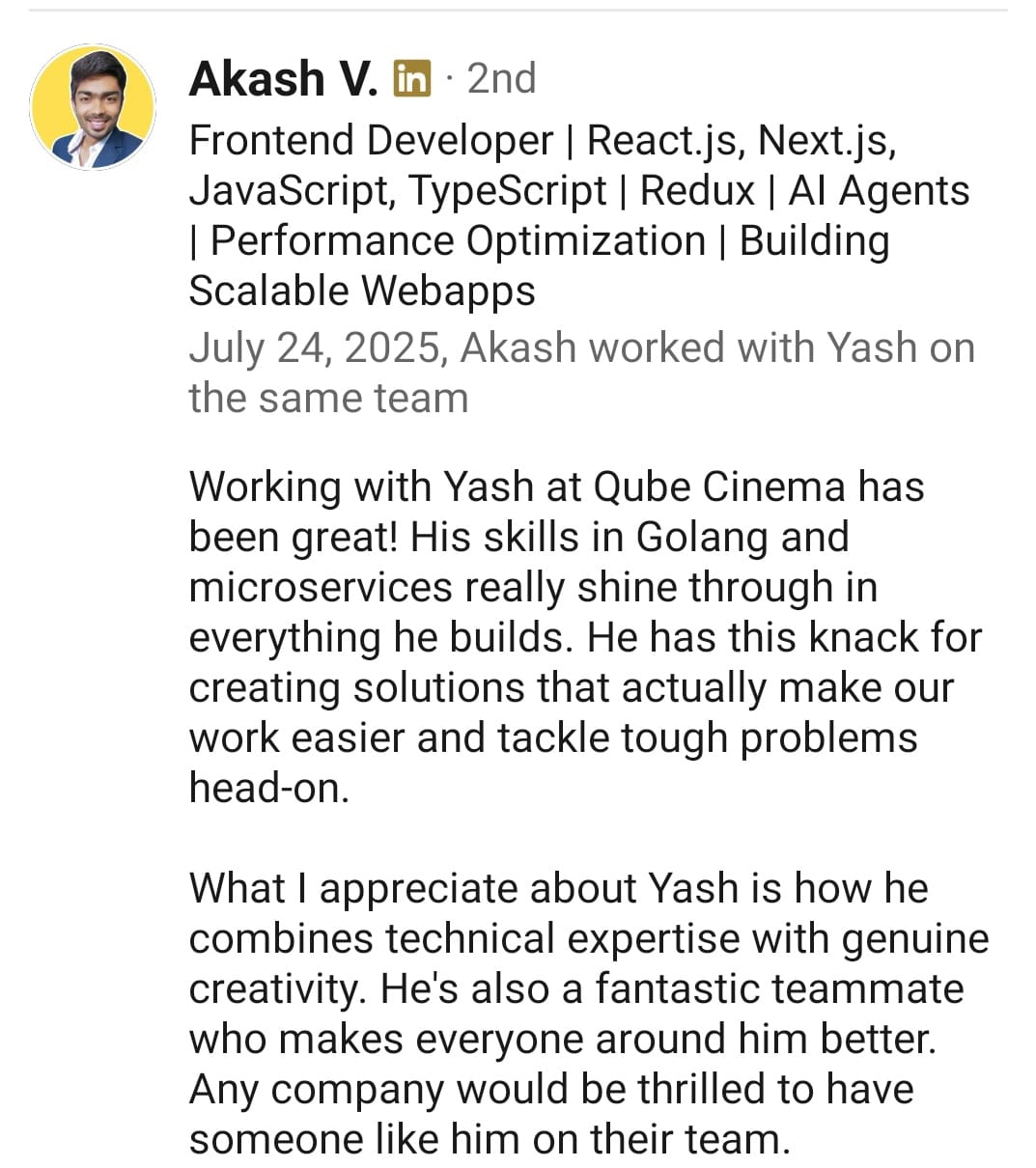
“Working with Yash at Qube Cinema has been great! His skills in Golang and microservices really shine through in everything he builds. He has this knack for creating solutions that actually make our work easier and tackle tough problems head-on. What I appreciate about Yash is how he combines technical expertise with genuine creativity. He's also a fantastic teammate who makes everyone around him better. Any company would be thrilled to have someone like him on their team.”
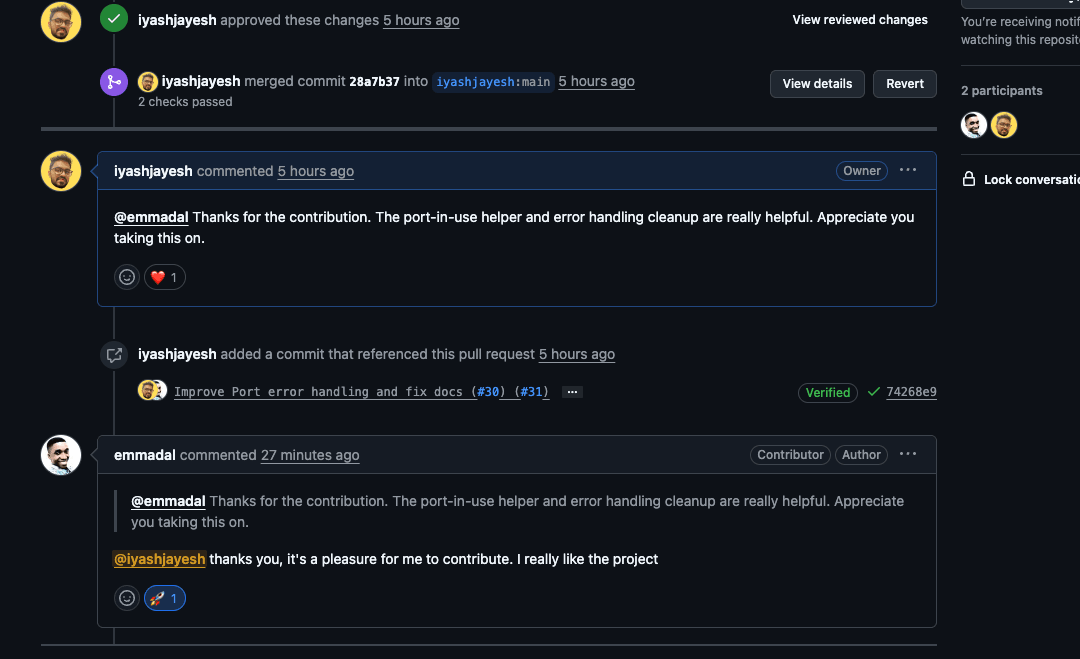
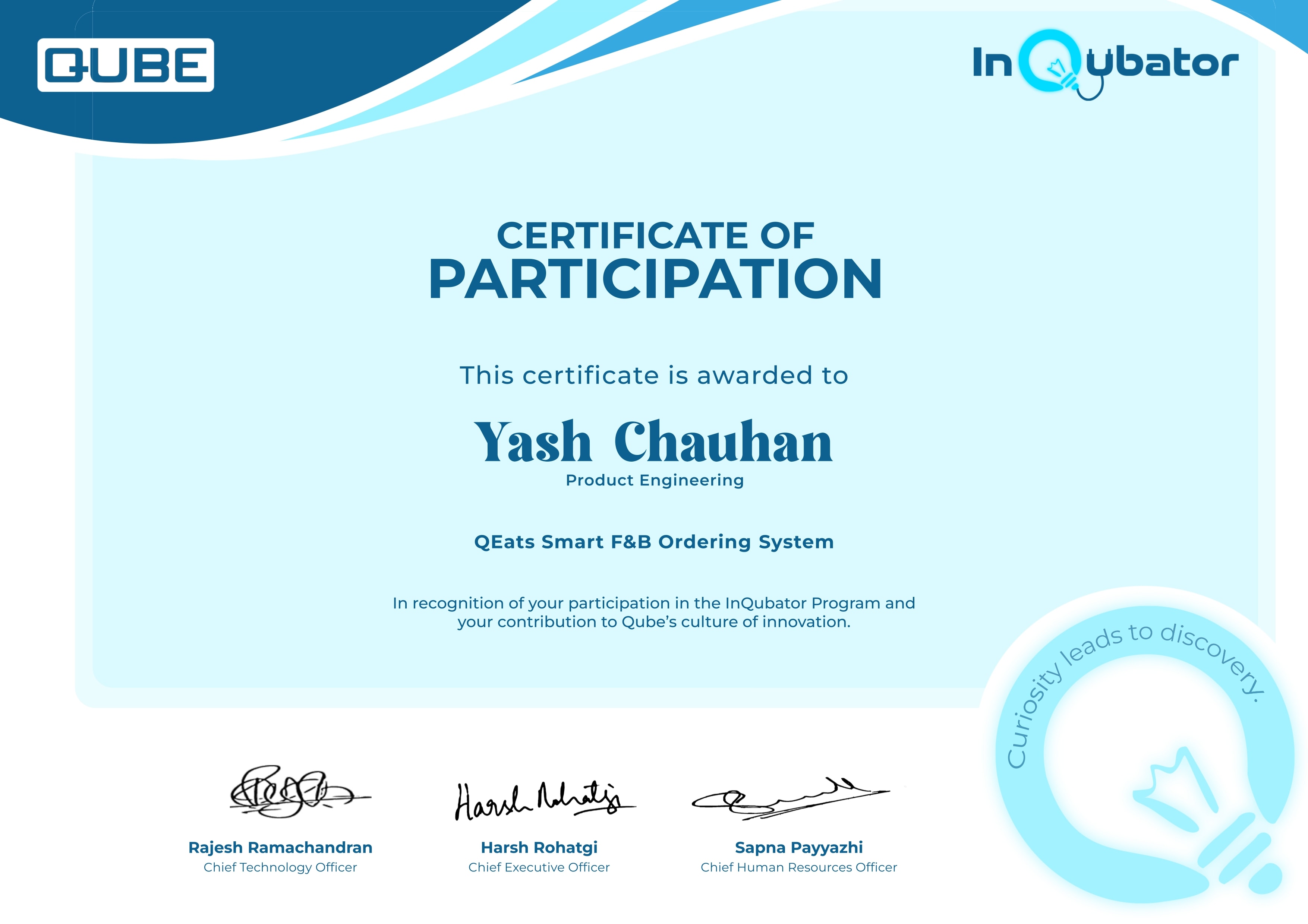
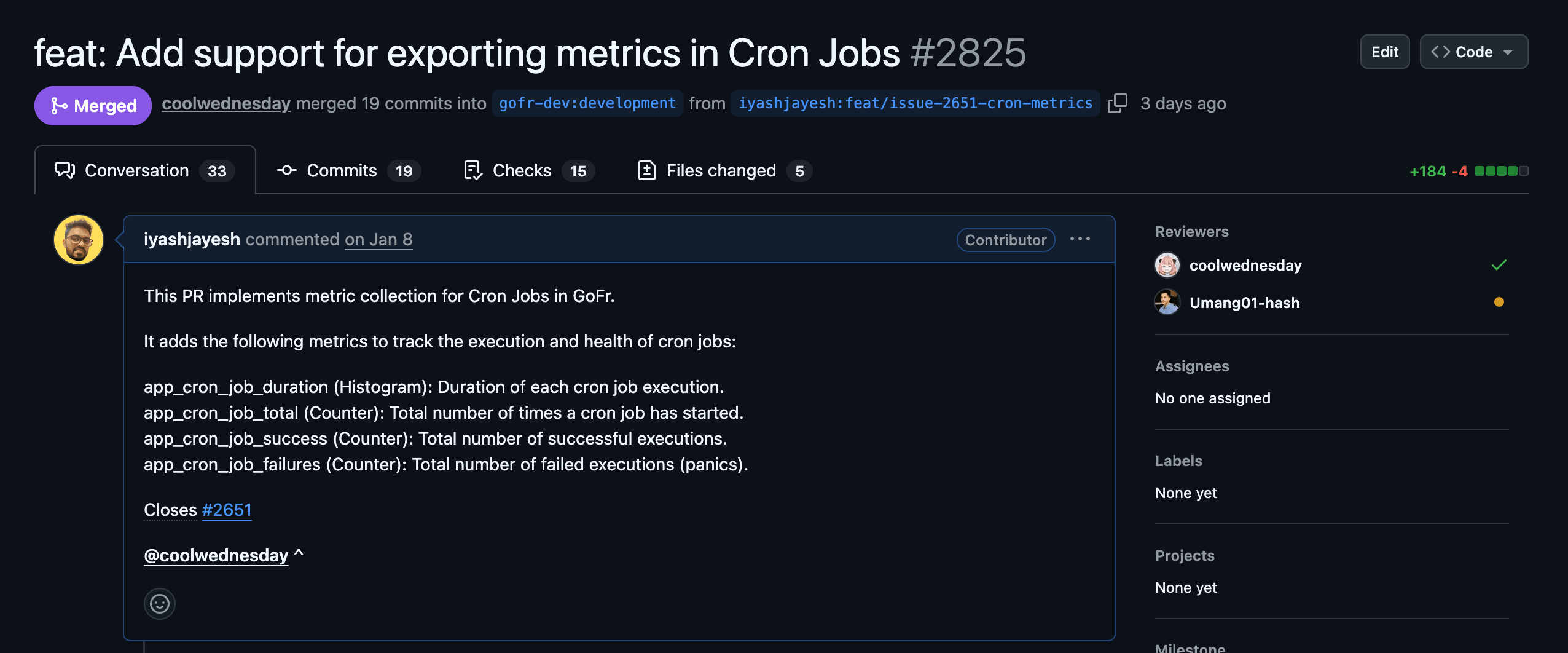
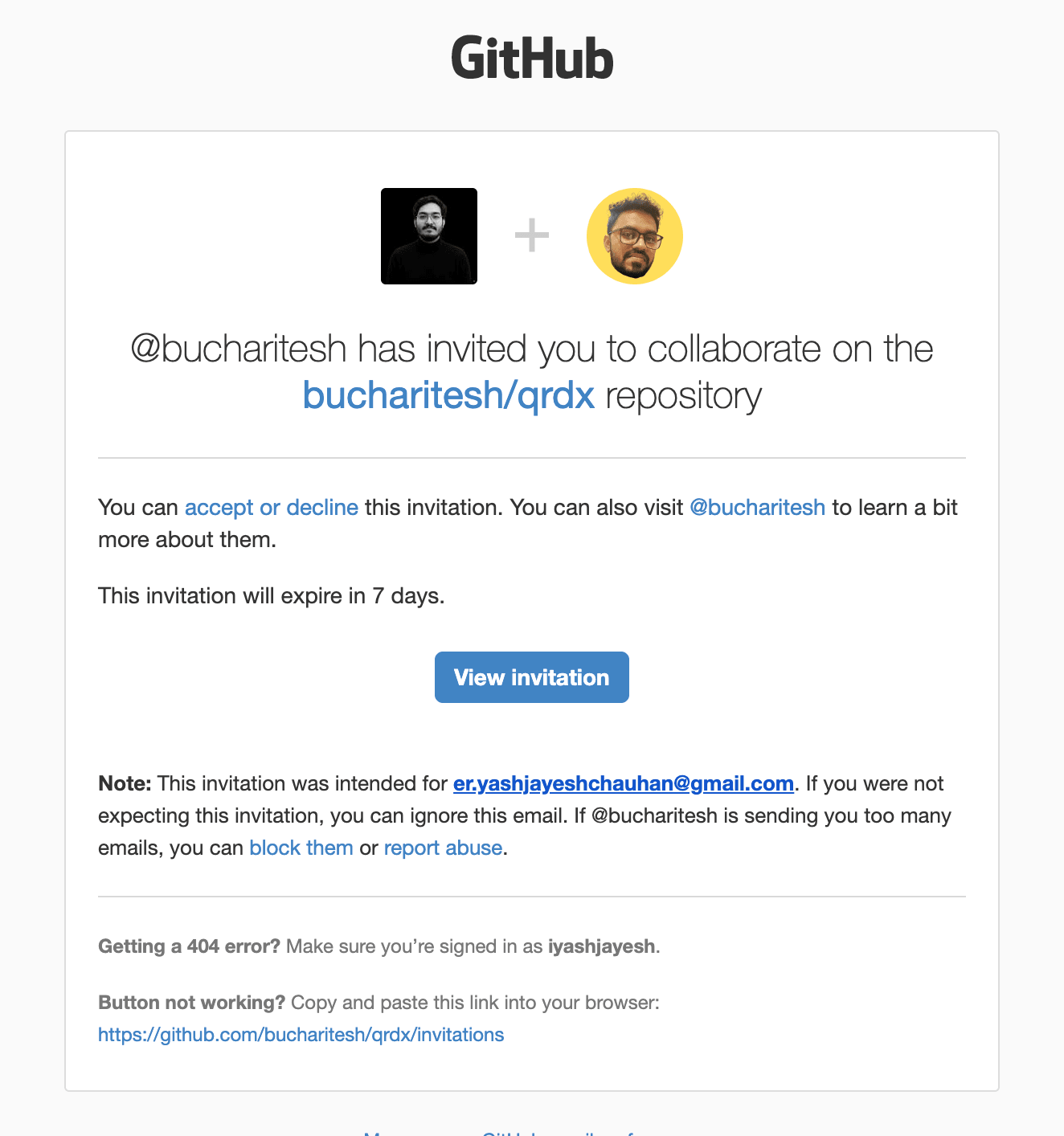
Contributions & Recognition
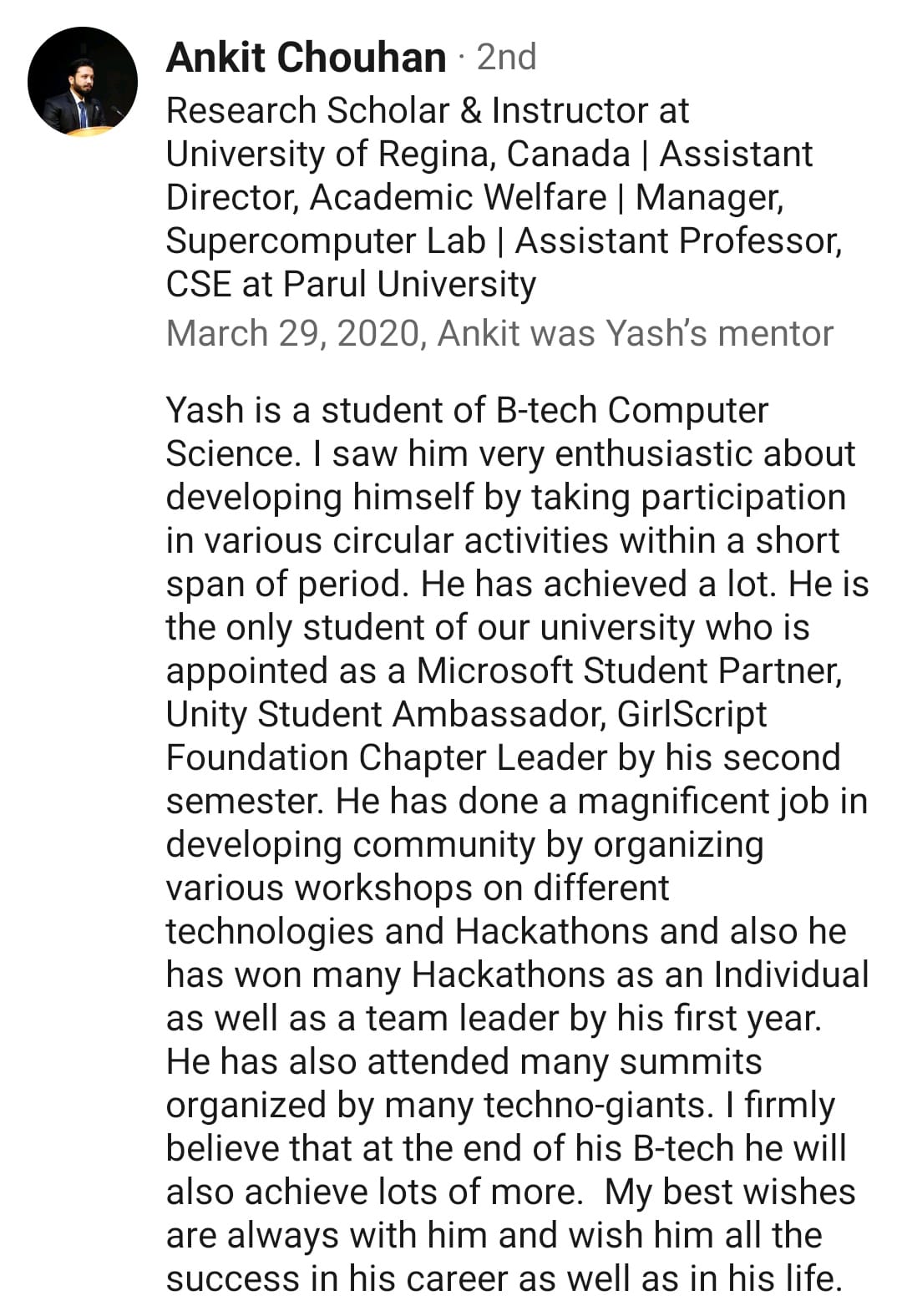
A showcase of my merged PRs, open source contributions, LinkedIn recommendations, work achievements, and professional milestones.







Research Work
Here are some of my research projects and publications.
- C
Cardiovascular disease prediction using classification algorithms of machine learning
Yash Chauhan
Cardiovascular disease is a major health burden worldwide in the 21st century. Human services consumptions are overpowering national and corporate spending plans because of asymptomatic infections including cardiovascular ailments. Consequently, there is an urgent requirement for early location and treatment of such ailments. The information which is gathered by data analysis of hospitals is utilizing by applying different blends of calculations and algorithms for the early-stage prediction of Cardiovascular ailments. Machine Learning is one of the slanting innovations utilized in numerous circles far and wide including the medicinal services application for predicting illnesses. In this research, we compared the accuracy of machine learning algorithms that could be used for predictive analysis of heart diseases and predicting the overall risks. The proposed experiment is based on a combination of standard machine learning algorithms such as Logistic Regression, Random Forest, K-Nearest Neighbors (KNN), support vector machine (SVM) and Decision Tree. Most of the entities in this world are related in one way or another, at times finding a relationship between entities can help you make valuable decisions. Likewise, I will attempt to utilize this information as a model that predicts the patient whether they are having a Cardiovascular disease or on the other hand not. Moreover, the data analysis is carried out in Python using Jupyter Lab in order to validate the accuracy of all the Algorithm. - D
Different sorting algorithms comparison based upon the time complexity
Yash Chauhan, Anuj Duggal
Sorting is a huge demand research area in computer science and one of the most basic research fields in computer science. The sorting algorithms problem has attracted a great deal of study in computer science. The main aim of using sorting algorithms is to make the record easier to search, insert, and delete. We’re analysing a total of five sorting algorithms: bubble sort, selecting sort, insertion sort, merge sort and quick sort, the time and space complexity were summarized. Moreover from the aspects of the input sequence, some results were obtained based on the experiments. So we analysed that when the size of data is small, insertion sort or selection sort performs well and when the sequence is in the ordered form, insertion sort or bubble sort performs well. In this paper, we present a general result of the analysis of sorting algorithms and their properties. In this paper a comparison is made for different sorting algorithms.
I write about what worked - and what didn't
Notes on backend engineering, system design, and lessons learned from shipping things. Here are my latest posts.
Get in Touch
I'm always up for talking Go, backend architecture, or open source. Reach me at iyashjayesh@gmail.com, or DM me on X or LinkedIn. If you're using one of my libraries and something's broken, open an issue - I read all of them. Let's build cool things together.